Click on the dates below for more information
Photo: Fermilab‘s Accelerator Rings, Courtesy U.S. Dept. of Energy
July 5, 1979
The Department of Energy authorizes Fermilab to build a superconducting accelerator, later named the Tevatron.
Next »
X
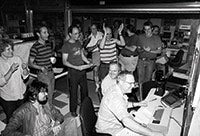
July 3, 1983
The Tevatron accelerates protons to a world-record energy of 512 GeV.
« PreviousNext »
X
October 1, 1983
Experiments begin. At first, a single beam of protons strikes a fixed target.
« PreviousNext »
X
October 13, 1985
The newly installed antiproton beam begins to collide with the protons. The CDF witnesses the first proton-antiproton collisions at 1,600 GeV.
« PreviousNext »
X
August 31, 1992
The first long run of collision experiments begins at an energy of 1,800 GeV.
« PreviousNext »
X
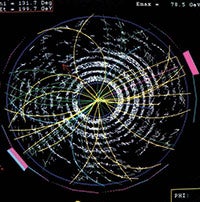
March 3, 1995
Scientists from the CDF and D-Zero experiments announce the discovery of the top quark.
« PreviousNext »
X
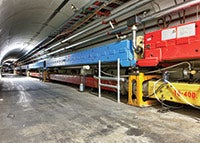
July 20, 2000
The DONuT experiment reports the first evidence for the direct observation of the tau neutrino.
« PreviousNext »
X
March 1, 2001
Upgrades push the energy up to 2,000 GeV, and the second collider run begins. Over the next decade its luminosity will more than quadruple.
« PreviousNext »
X
August 4, 2008
Tevatron scientists announce that the Higgs boson does not have a high mass of 170 GeV. More searching is required.
« PreviousNext »
X
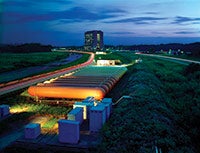
September 30, 2011
The Tevatron produces its final proton-antiproton collisions; data analysis will continue for several years.
« Previous
X